
September 3, 2026 · Michael Lynn
LanceScope: A Workbench for Reading LanceDB Datasets
A console, CLI, MCP server, and macOS app for understanding a LanceDB database — schema, versions, indices, fragments and rows, with the byte cost of every read shown as you go.
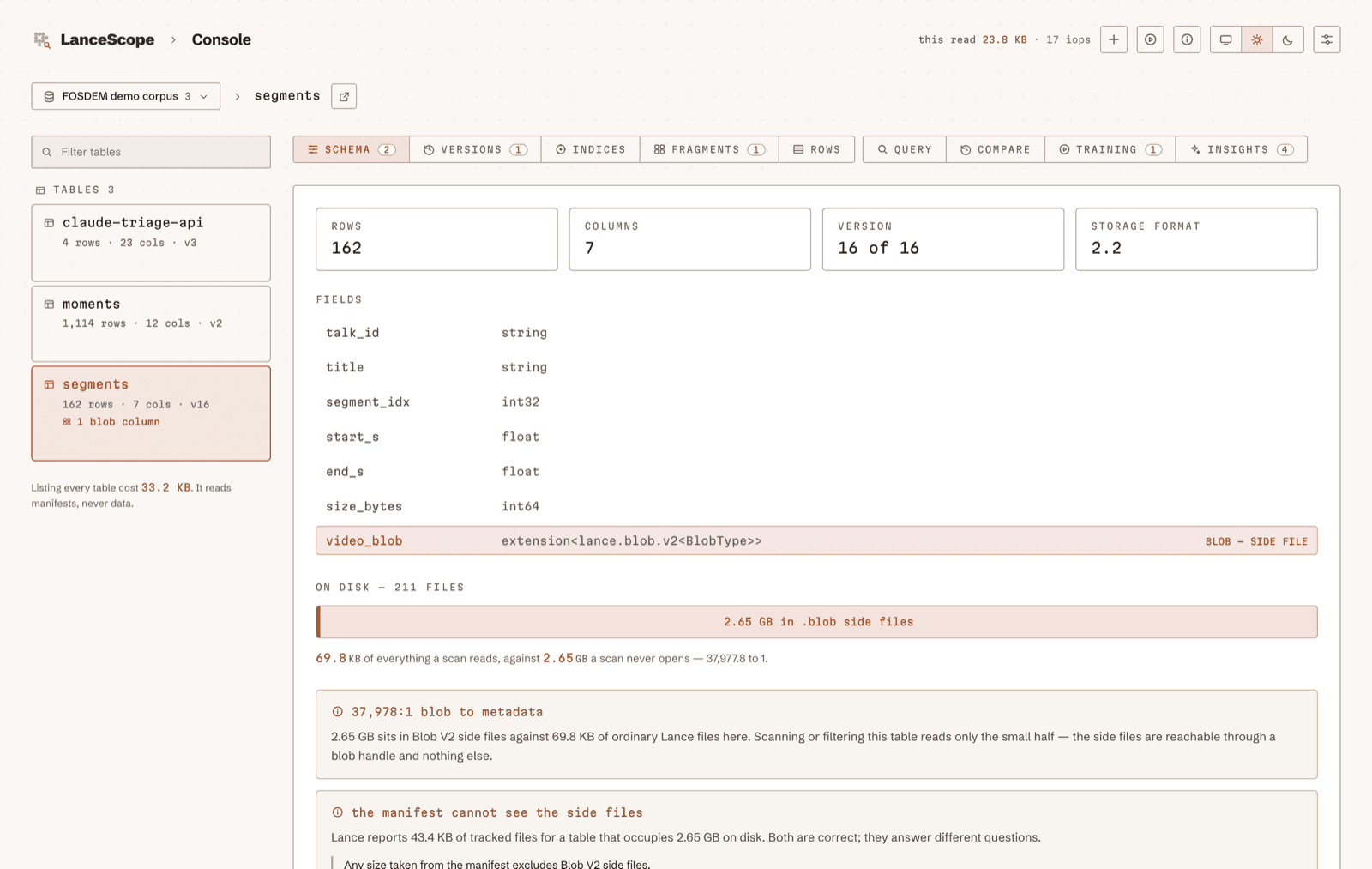
LanceScope: A Workbench for Reading LanceDB Datasets
Site: lancescope.mlynn.dev · Live console: demo.lancescope.mlynn.dev/console · Docs: lancescope.mlynn.dev/docs · Repo: github.com/mrlynn/lancescope
LanceScope is a workbench for understanding a LanceDB database: what's in it, why it
behaves the way it does, and what every answer cost to get. Schema, versions, indices,
fragments and rows, each with the bytes it took to read them printed next to it.
The LanceScope console
1 / 5
The property it was built around
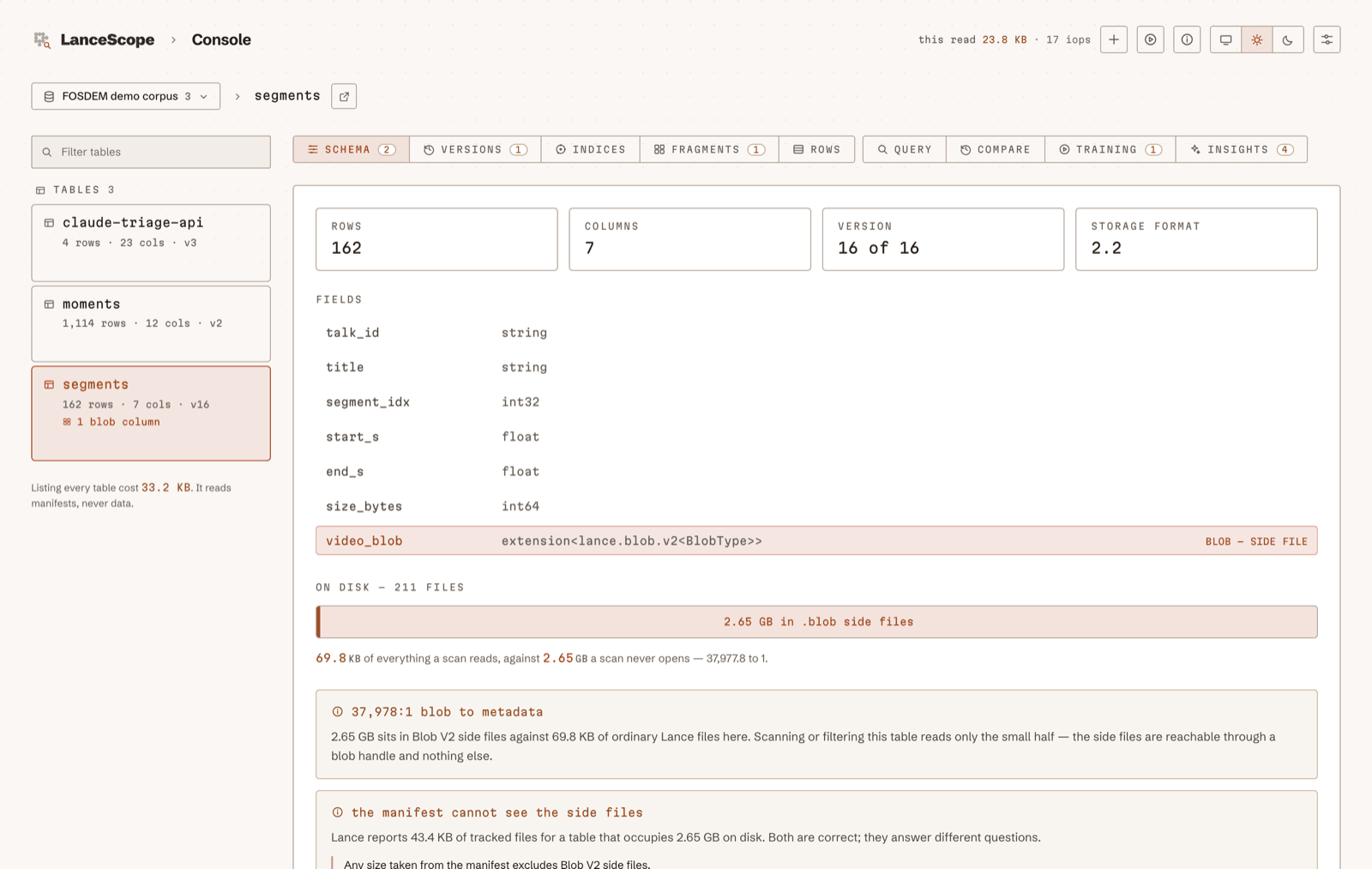
A Lance table can hold gigabytes of video in a Blob V2 column while a search over that
table reads kilobytes. The bytes a search touches and the bytes a table holds live in
different files, so they're free to diverge, and on the demo corpus they diverge by a
factor of 132: 2.65 GB of video in
.blob side files against 20.0 MB of everything a
search actually opens.Most tools show you the same result either way. LanceScope measures both, from Lance's
own IO counters, and puts the number next to whatever you just did.
Four interfaces
Web console. Browse a Lance directory (or a Hugging Face URI, read over the network
without downloading anything), inspect schemas and versions and fragments, run scalar,
full-text, vector or hybrid searches, and see which access path Lance chose along with
what it read. Heavy columns are described from the schema rather than materialised, so
browsing a table holding gigabytes of video costs kilobytes.
CLI. Headless ingestion and scanning. Survey a directory of media, check what the
current build can decode, and build Lance tables with progress reporting.
MCP server. Seven read-only tools —
list_tables, describe_table, read_rows,
table_findings, table_fragments, table_indices, table_versions — so an agent
gets the same evidence the console shows instead of guessing.macOS app.
make app produces a self-contained LanceScope.app with its own
title bar, running a server it starts and stops itself. No Python, no Node, no Lance
on the target machine. 160 MB as a DMG.All four share the same core. The CLI and the console call the same functions in
ingest.core, and the MCP server wraps the same HTTP routes the console uses, so
there's nowhere for the behaviors to drift apart.Findings, derived rather than generated
A set of rules runs over the same manifests the other tabs read — seven when I wrote
the guide page, ten by the time the README caught up. An unindexed vector column. Small
file counts that would mislead if you acted on them. Tombstone debt. A manifest that
understates the size of the thing it describes. Each finding carries the numbers it
was computed from on the same row, and each also shows up under the panel holding
those numbers.
No model is involved in any of it. It's arithmetic over metadata Lance already reports.
Optional language layer, fully metered
With a local Ollama model, an Anthropic API key, or any OpenAI-compatible endpoint,
LanceScope will translate a question into a filter and describe a table in a few
sentences. Every response reports the tokens and the dollars it spent beside the bytes
it read. A tool built to make read cost visible shouldn't hide inference cost.
The write boundary
Reading a table cannot change it, and that's checked rather than asserted: a test
drives the entire read API and every MCP tool over a real corpus, then verifies that
not one byte on disk moved.
The ingest wizard is the only thing in the project that writes a dataset, and it's
create-only by construction. It refuses a destination that already exists, only ever
appends into a table it made itself during that run, and has no reachable path to an
overwrite. The whole write surface is one module, and CI fails if a dataset mutation
shows up anywhere else.
Running it
bash code-highlightgit clone https://github.com/mrlynn/lancescope && cd lancescope
make setup
make dev
Open
localhost:3000/console and point it at a directory holding .lance tables.
Needs uv and Node 22.In a container, there's one image per Lance reader, because a Lance reader isn't
universal — a dataset written by one version may need that version to read it. The tag
names the reader:
bash code-highlightdocker run --rm -p 8088:8080 \
  -v /path/to/your/lance:/data:ro \
  ghcr.io/mrlynn/lancescope:pylance-11.0.0
No database handy?
make ingest LIMIT=8 builds the demo corpus from a handful of
conference talks, giving you two tables: moments (keyframes with embeddings) and
segments (playable video chunks in Blob V2 columns).Where it came from
LanceScope grew out of a conference demo called Ctrl-F for Video, where the video and
its index are the same table. You type "a diagram with boxes and arrows," get frames
back from a corpus of talks, click one, and the video plays at that second while a
meter along the bottom shows how few bytes moved to make it happen. Building the meter
turned out to be more interesting than the demo, so it became its own tool.
LanceScope is Apache-2.0 and works with LanceDB 3.0+ on macOS, Linux, and in
containers.